

Amidst the biting winds and the encroaching darkness of a November day in Helsinki, I stumbled upon a different kind of warmth yesterday.
The energy I witnessed wasn’t from a political rally or traditional cultural event — it was the buzz of innovation, new dreams, and the determination to build a new future.
There’s a well-known and somewhat complicated concept in development economics. It says that countries that only produce and export raw materials can never truly become wealthy. The theoretical explanation is long and perhaps not fascinating for most readers.
But put simply, the essence is this: No nation can achieve economic transformation by selling only raw materials — coffee, corn, tea, jute, and carpets. To become prosperous, any country must achieve a ‘breakthrough’ in some sector.
In other words, nations become wealthy by creating companies like Tesla, Apple, or China’s Alibaba. Speaking of Finland itself, it’s companies like Nokia, Kone, and Wolt that create the possibility for national prosperity.
This concept was advanced by Latin American development scholars in the 1960s. I’ve heard that Nepal Rastra Bank Governor Dr. Bishwa Paudel now repeatedly echoes this argument in various interviews.
And rightly so. We Nepalis don’t have our own ‘global brands.’ For decades, we’ve been merely consumers of technology others built, or workers building someone else’s technology.
But what I saw yesterday in Helsinki made me think — and made me cautiously optimistic. Perhaps the fate of Nepal and Nepalis, who export cheap labor and cheap raw materials, will change in the coming years or decades. I felt that some Nepali, somewhere, will stand at the forefront of technological disruption and create something new and massively successful.
Finland’s First Nepali Tech Gathering
Right now, Helsinki is hosting Slush, one of the world’s largest startup festivals. According to organisers, the event features 6,000 startups from around the world, nearly 4,000 investors, and tens of thousands of participants.
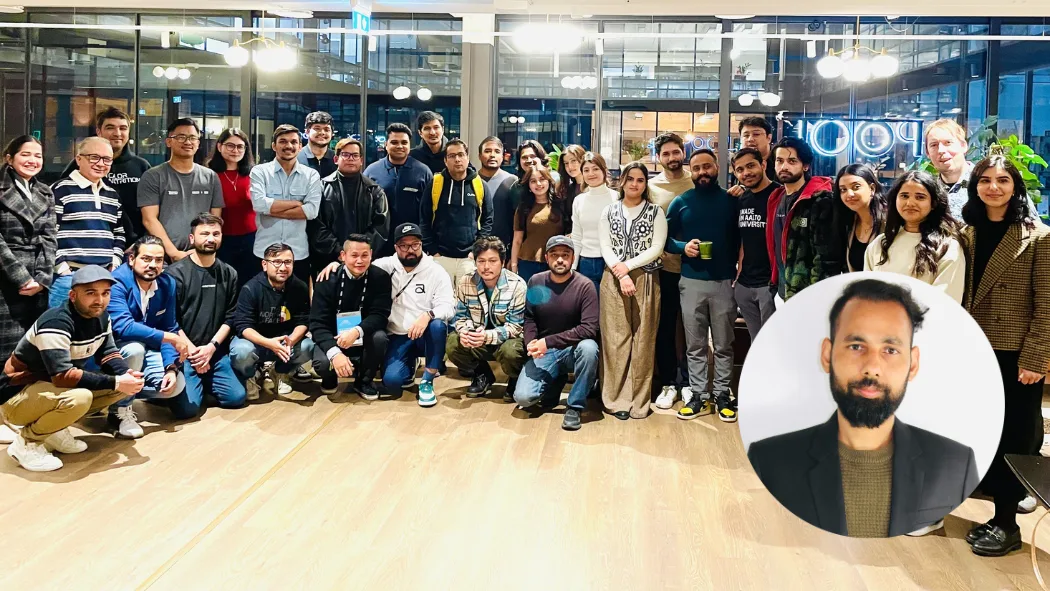
In the midst of this global convergence of investors and entrepreneurs, a gathering was organised for Nepali ‘tech startups’ in Finland — a Startup and Networking Event. This was the first ‘tech event’ of its kind organised by the Nepali community in Finland.
The event was led by ‘Bato Oy,’ a new company recently launched by Bikash Gurung, known as the host of the video podcast series “New Heights with Bikash,” along with companies run by young Nepalis like Nordes and Resimator. Sitting at the event, where roughly 95% of participants were Nepali, it felt like Helsinki’s heart was hosting its own ‘mini Nepali Slush‘ — and something was brewing beneath the surface.
The event was held at Nordes company headquarters, which itself felt like living proof of Nepali entrepreneurship. Like Silicon Valley tech startups, it had a comfortable and well-equipped office. The organisers provided free pizza, coffee, and other refreshments.
Diverse Innovations
Before attending the event, I expected the usual: generic website development, small apps, or software outsourcing.
But the presentations from the companies left me stunned. These weren’t just bringing new concepts — some had thousands of active users, others had secured or were in the process of securing lucrative contracts with Finnish universities and municipalities.
The most fascinating startup I heard about was called Aveksana.
Created by a team of Nepali youths educated in Finland, the platform connects over 20,000 thesis-writing students and their supervisors from nearly every country in the world. They explained their extensive use of AI in their work.
“Which AI do you use? ChatGPT or something else?” I asked Surya Yadav, one of the company’s founders.
“No, we’ve developed our own AI system,” he answered confidently before my question had even settled.
They had been developing a new AI model for several years, based on data from their platform’s users.
Pointing out the limitations of commercially available AI tools, Yadav gave a lengthy technical explanation of how their AI system is more effective for academic research. Much of it went over my head.
But his confidence and the fact that some Finnish universities had already adopted their system made me believe in what he was saying.
Similarly inspiring stories came from Chetan Singh, CEO of Nordes, and Barun Basyal of Resimator. Nordes, which manufactures various equipment for ships, is preparing to build its own special boat. Resimator, meanwhile, has expanded with a branch in the USA and is preparing to revolutionise the restaurant business sector using technology.
These companies, with annual revenues in the millions of euros, aren’t just operating in Finland — they’ve also built teams in Nepal, providing employment to dozens of Nepalis.
Before attending the event, I expected the usual: generic website development, small apps, or software outsourcing.
But the presentations from the companies left me stunned.
The Immigrant Entrepreneur’s Struggle
In informal conversations after the event, stories told by the founders of Cogknit and Lukla AI painted a vivid picture of the immigrant entrepreneur’s reality.
They shared their experience of how it was difficult in the beginning as international entrepreneurs. But after persistent effort, they’re now in the process of securing business contracts with Finnish municipalities.
Another beautiful aspect of the event was its modesty. There were no loud speeches, no unnecessary commotion. There was only pure curiosity, warm companionship, and a spirit of lifting each other up.
Even for non-tech people like me, the atmosphere was engaging, moving, and energizing.
Gopal Aryal, who has been established in business in Helsinki for a long time, seemed to feel the same way.
“Ten to fifteen years ago, when Nepali students came and said ‘we can build websites ourselves,’ we’d be so happy that our own brothers could build websites,” Aryal said emotionally. “But today, seeing this level of progress just a few years later, hearing about AI and global companies — I’m happy beyond words.”
The essence of Aryal’s joy was: We’re no longer limited to just washing dishes or cooking — we’re writing ‘code’ and drawing a new future for ourselves and our country.
A Chance Encounter
Leaving the event and heading home on the train, I happened to meet two young Nepali men. Both had spent the day delivering food for Wolt and were heading back. Both were IT students and fully aware of Slush.
“Couldn’t make it because of work,” they said. “There’s such a rush of work. Couldn’t leave it.”
We had a delightful chat for a while. From AI to blockchain, from NPL to Nepal’s Gen-Z movement, they were aware of everything. They’d been studying in Finland for two years. One was from Chitwan, the other from Dharan.
They shared their dream of doing something in the IT sector after completing their studies and contributing to Nepal’s development.
The young men, exhausted from a full day’s work, got off one stop before me. After they left, my heart felt a bit heavy.
Any work is respectable, of course. Yet I thought — if these sharp young minds had been born in a slightly better country, perhaps instead of carrying food all day, they’d already be running their own startups and creating employment.
However, getting off the train, I remembered the event I’d just attended and thought: The journey has already started. It’s just a matter of time.